Revolutionizing clean transportation
Answering heavy mobility challenges
Transport accounts for 25% of global emissions, 70% of which directly caused by road transport (freight and passengers).
Whilst existing technologies will keep improving, the development of new solutions is unavoidable to reach the Paris
agreement objectives. Hydrogen is one of the key solutions to tackle the mobility challenge, and it is particularly well suited
to answer the needs of intensive mobility and heavy transport.
Liquid hydrogen

Accelerating hydrogen road mobility
There are already around 50,000 fuel cell vehicles on the roads (mostly cars), representing a global demand of 100 tonnes per day.
Hydrogen: a key solution for heavy mobility
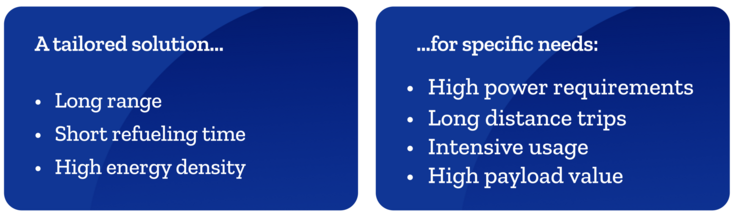
Hydrogen is well positioned as a solution to decarbonize intensive mobility (public and freight transport) because it answers unavoidable criterias for decision makers: weight, space and cost amongst others. With larger vehicles or used more intensely, hydrogen can offer the best of all worlds: a short refueling time for a long range autonomy.
Depending on its usage, the need in hydrogen
depends on the vehicule type, ranging from
0.35 kg per day for a car, to 30 kg for a bus, and
70 kg for a truck.


2035
first commercial hydrogen aircraft
Decarbonizing aviation, from the ground to the air
The aviation industry has committed to being net zero by 2050. Its climate impact goes far beyond CO2 emissions (NOx). For aircraft as well as for airports, liquid hydrogen can best answer the challenge of decarbonizing aviation. As the first hydrogen-powered commercial aircrafts are expected by 2035, airports need to adapt their infrastructures as of today.
Hydrogen can be used for many applications in and around the airport. Itwill be used for propulsion either by direct combustion or by powering a fuel cell. hydrogen can also serve other ground mobility usages, notably heavy duty mobility or light ground support equipment.
What are the benefits of hydrogen for the aviation?
- The cheapest decarbonised aviation fueI
- The only low carbon alternative to kerosene with synfuels (CO2 + AOx@
- High energy density

120K
ships worldwide in commercial fleet today
Creating sustainable pathways to a zero carbon maritime industry
The maritime transport sector accounts for 3% of CO2 emissions per year on a global scale. Hydrogens very high energy density allows a zero-emission maritime transportation, while having minimal impact on cargo space. If as of now, almost the entire fleet uses diesel
engines, new and greener propulsion systems are an increasingly important subject for the sector. Hydrogen is expected to play a key role. We offer new avenues for zero-emission mobility in the maritime transport sector while bringing public awareness and technological innovation for waterborne transportation.
What are the benefits of hydrogen for the maritime industry?
- Zero-emissio
- Higher operational range vs batterie
- Suited for the average power requirements